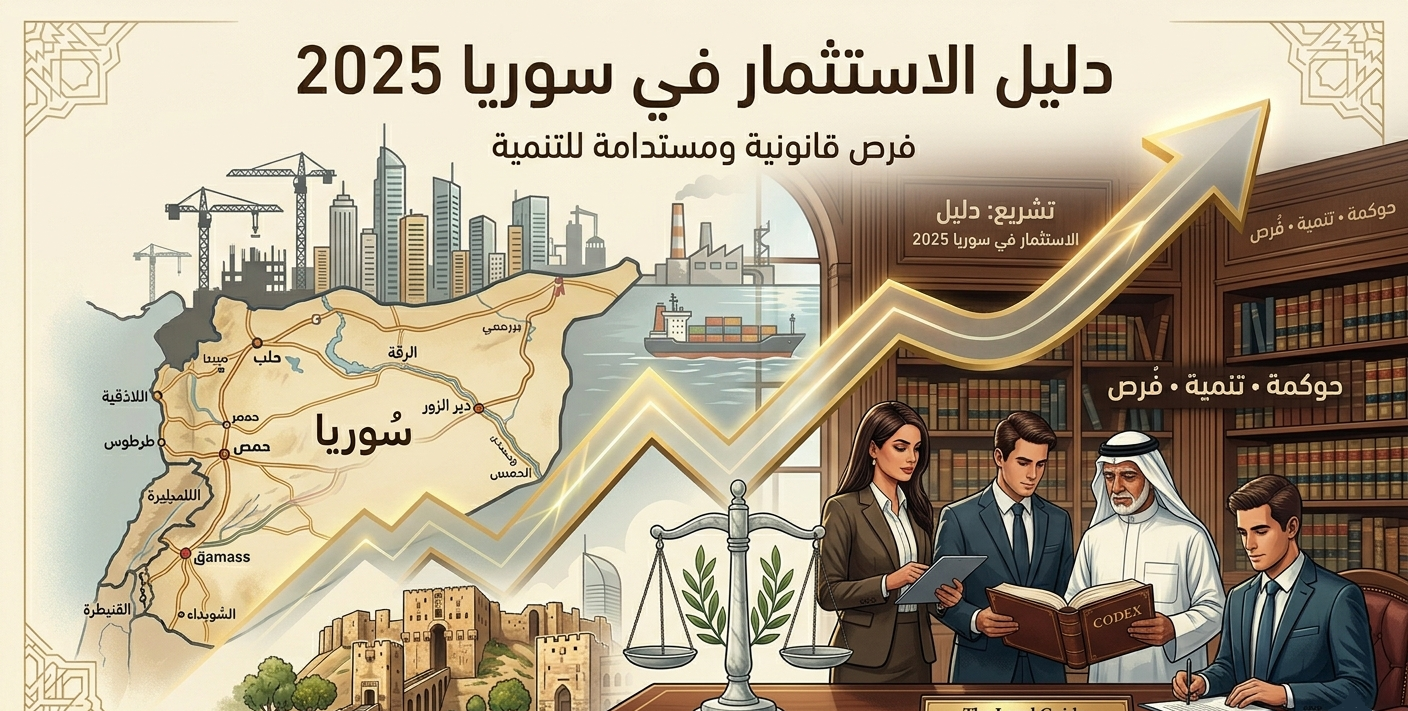
A Guide to Investing in Syria 2025
2026-05-13 · 4 min
I. Legal and Legislative Framework (Critical 2025 Amendments)
The Syrian legislative body restructured the corporate sector by issuing Legislative Decree No. 114 of 2025. This decree introduced pivotal amendments to Investment Law No. 18 of 2021, effectively streamlining procedures and establishing a highly secure environment for foreign investors.
1. Unprecedented Guarantees for Foreign Investors
- 100% Full Ownership: Foreign investors can fully own investment projects without requiring a local partner in most sectors.
- No Expropriation: The law explicitly prohibits the seizure, confiscation, or freezing of investment projects by government entities without a final court ruling.
- Free Capital Transfer: The new legislation guarantees the absolute freedom to transfer profits, capital, and interest abroad in foreign currencies.
- Foreign Labor Exemption: Investors have the right to hire foreign experts, secure their residency/work permits, and transfer their wages abroad.
2. Tax and Customs Incentives
- Agricultural Sector: Permanent 100% tax exemption for all agricultural and livestock production projects.
- Industrial & Export Sectors: Up to an 80% income tax reduction for industrial, medical, waste recycling, and export-oriented projects.
- Customs Exemptions: Full exemption from customs duties on machinery, equipment, production lines, and service vehicles imported for licensed projects.
3. Procedural Streamlining & Dispute Resolution
- Investor Services Center: Activation of a single-window system to issue corporate licenses rapidly and eliminate red tape.
- State Land Allocation: Decree 114 grants the Supreme Council the authority to allocate state-owned lands to investors under highly competitive economic terms.
- Arbitration Centers: Provisions allowing the establishment of private arbitration centers alongside flexible alternative dispute resolution (ADR) mechanisms.
II. Sectoral Map & Key Investment Opportunities
Syria has entered a phase of calculated economic opening, with the Syrian Investment Authority registering massive capital injections across infrastructure and core facilities. The most lucrative sectors for 2025/2026 include:
1. Real Estate Development & Reconstruction
The Syrian market suffers from a massive deficit in residential and commercial real estate due to years of stalled projects. With over 1.2 million citizens returning to the country, there is an urgent demand for:
- Constructing modern, cost-efficient suburbs and linear cities.
- Investing in factories for building materials, cement, and steel to meet skyrocketing local demand.
2. Tourism & Hospitality Sector
Syria faces a severe shortage in hotel capacity. Currently, the country possesses fewer than 14,000 operational hotel rooms, while the market requires the development of at least 27,000 new rooms in the coming years. This makes hospitality investments exceptionally high-yielding.
3. Renewable Energy & Infrastructure
Solar and wind energy projects are top priorities for the Syrian government to bridge the electricity deficit. Opportunities in this sector include:
- Generating power and selling it directly to the national grid or industrial cities.
- Rehabilitating and managing vital facilities (airports, seaports, and railways) via Public-Private Partnerships (PPP) or long-term concession contracts.
4. Agriculture & Export-Oriented Food Industries
Backed by a 100% tax exemption, investing in agro-processing, greenhouses, and food packaging represents a strategic opportunity that ensures fast returns through exports to regional and Gulf markets.
III. Incorporation Requirements & Corporate Setup
To secure an investment license and establish a corporate entity under the updated laws, investors must follow these steps:
- Select Legal Structure: Choose between a Limited Liability Company (LLC), a Joint Stock Company (JSC), or registering a branch of a foreign company.
- Document Submission: Provide identification documents, articles of association, corporate bylaws, and proof that the project's allocated land is free of legal disputes.
- Minimum Capital Requirements: The law sets flexible capital thresholds depending on the industry, while requiring that at least 60% of the workforce be Syrian nationals (provided local expertise is available).
Conclusion and Strategic Recommendation
Investing in Syria is no longer just an exploratory concept; it has evolved into a reality backed by regional diplomatic momentum and a solid legal shield provided by Decree 114. Successful market entry requires rigorous feasibility studies, a deep understanding of local supply chains, and leveraging the fast-track windows offered by the Syrian Investment Authority.